
The Capitalist's Case for Nationalizing AI
Why the most persuasive case for nationalizing AI didn't come from a socialist. It came from a venture capitalist doing arithmetic.
There is a number that built the modern world, and almost nobody outside of a few finance and engineering circles has ever thought about it. It is not a stock price or an interest rate. It is something quieter and stranger: the marginal cost of adding one more user.
For Google, that number was effectively zero. One more search query cost the company essentially nothing. The servers were already running, the index was already built, the algorithm was already trained. A person typing a question into the box was not a cost. They were free money waiting to be monetized. The same was true at Facebook. One more profile, one more login, one more scroll through the feed—the incremental cost of that person was a rounding error, lost in the noise of a budget measured in tens of billions.
This is the secret behind the most profitable companies in human history. It was never just that they were clever, though they were. It was the physics of their business. They had built something that could scale to a billion people, then two billion, then three, while the cost of serving each additional person flatlined near nothing. That is the money printer. Infinite reach at zero marginal cost. Once you understand that number, the obscene profit margins stop being a mystery and start being inevitable.
So when Chamath Palihapitiya sat down to explain why he thinks AI is fundamentally different from the internet, he started with that number. And then he watched it break.
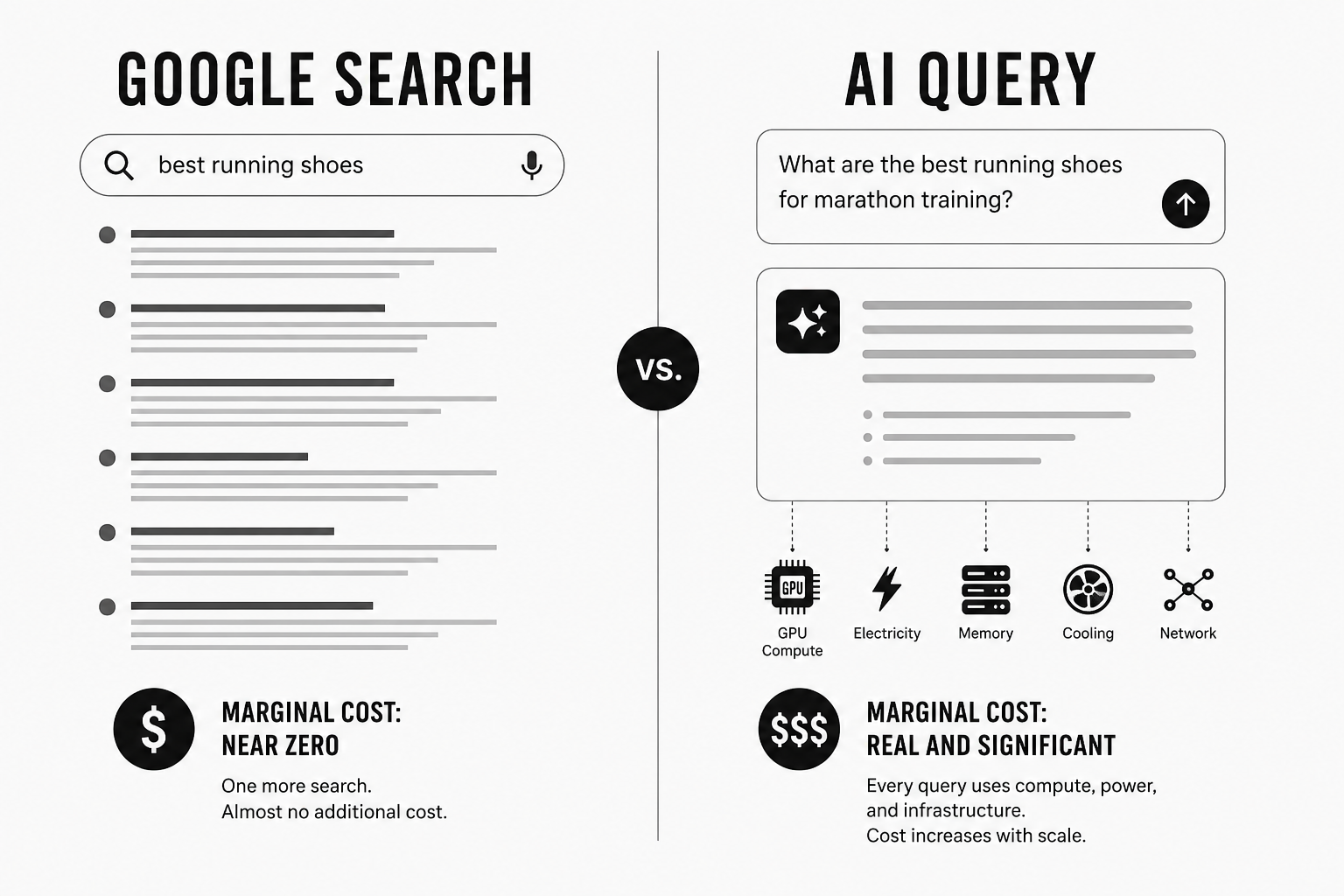
Here is the thing about an AI query that is not true of a Google search. It is expensive. Not metaphorically expensive—literally, physically, electrically expensive.
Every time you ask an AI model a question, somewhere a graphics processing unit lights up and burns through electricity. Memory is allocated. Compute is consumed. The response that comes back to you, the one that feels instant and weightless, cost real money to generate. And here is the part that matters: it costs that money every single time. The thousandth query is not cheaper than the first. The billionth user does not ride free on infrastructure already paid for. Each interaction taxes a chip, draws power, and adds to a bill that someone, somewhere, has to pay.
Palihapitiya knows this not as a theory but as a line item. His own software startup, 8090, watched its AI costs more than triple in a matter of months, trending toward eight figures a year—a bill split across inference costs, coding tools, and model providers. His revenues, he noted dryly, were not tripling along with them. The marginal cost of AI did not vanish at scale the way Google's did. It just kept showing up, query after query, invoice after invoice.
This is the crack in the foundation. The internet companies got rich because their costs disappeared as they grew. AI companies face the opposite curve. Growth is not free. Growth is the bill. You cannot print money the same way when every dollar of revenue drags a real cost behind it.
That alone would be an interesting observation about unit economics. But it is not the part of the argument that lands hardest. The part that lands hardest is about who built the ground all of this is standing on.
Think for a moment about what an AI company actually needs to exist.
It needs enormous data centers, which need land, which needs permitting. It needs electricity—staggering amounts of it—which means it needs a power grid, the kind that takes decades and public money to build. It needs its chips, which are among the most valuable and most coveted objects on earth, to be protected from theft by foreign adversaries, which means it needs a national security apparatus. It needs roads to those data centers, water to cool them, legal systems to enforce its contracts, and a stable society in which all of this can function.
None of that was built by OpenAI. None of it was built by Anthropic. It was built by the public. By taxpayers. By decades—generations—of government investment in the physical and legal foundation that these companies are now quietly running on top of, the way a tenant runs on top of a building they did not construct.
This is where Palihapitiya reached for a comparison that makes the whole thing click into place. Imagine, he said, that the federal government built the interstate highway system. The roads, the interchanges, the maintenance, the rules of the road—all of it paid for and maintained by the public. And then imagine that two private companies came along and used those roads to transport every good in the country, capturing the profit from all that commerce.
At some point, a reasonable person who built and owns the roads would ask a simple question: How much of this should I own? You are riding on my rails.
It is not a radical question. It is a landlord's question. It is the question any party would ask if they had built the thing that made someone else's fortune possible. And it reframes the entire debate about AI ownership, because it shifts the ground from ideology to leverage. The issue is not whether the government deserves a stake on some moral principle. The issue is that the government is, in a very literal sense, the infrastructure provider—and infrastructure providers, when they have the leverage, negotiate for a share.
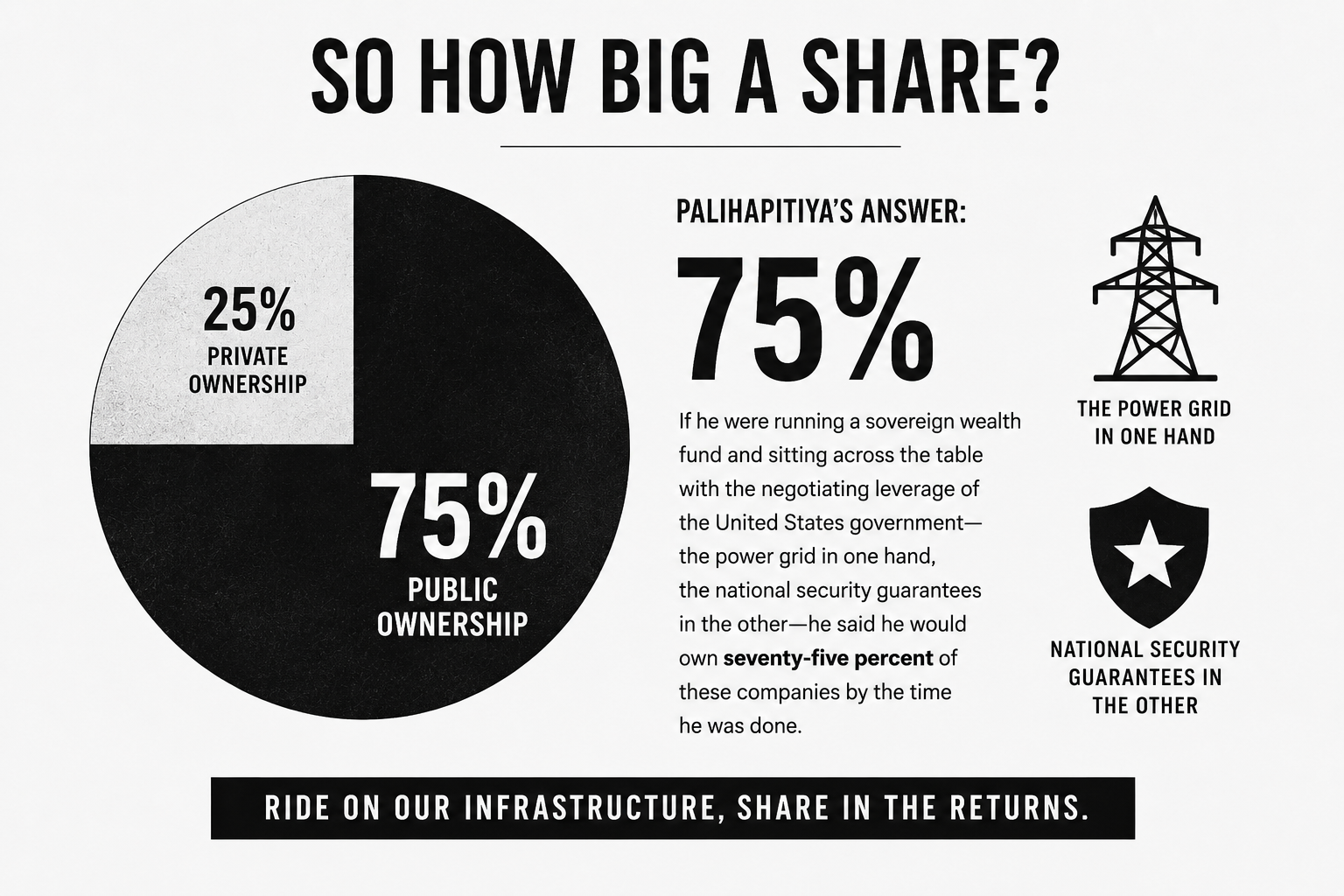
So how big a share? Palihapitiya's answer was not hedged. If he were running a sovereign wealth fund and sitting across the table with the negotiating leverage of the United States government—the power grid in one hand, the national security guarantees in the other—he said he would own seventy-five percent of these companies by the time he was done.
Seventy-five percent. Not a tax. Not a regulation. Ownership. A controlling stake, justified not by politics but by the brute facts of who built what.
What makes this argument unsettling—and genuinely original—is where it comes from. This is not a redistribution pitch from the left. There is no appeal to fairness, no language about billionaires or inequality, nothing that would sound at home in a Bernie Sanders stump speech. It is the opposite. It is a capitalist's argument, made in the native tongue of capital: leverage, ownership, equity stakes, returns on investment. It arrives at a conclusion that sounds almost socialist by walking a path that is purely, coldly commercial.
And that is exactly why it is so hard to wave away. You can dismiss a moral argument by disagreeing with its morals. It is much harder to dismiss an arithmetic argument by disagreeing with its arithmetic.
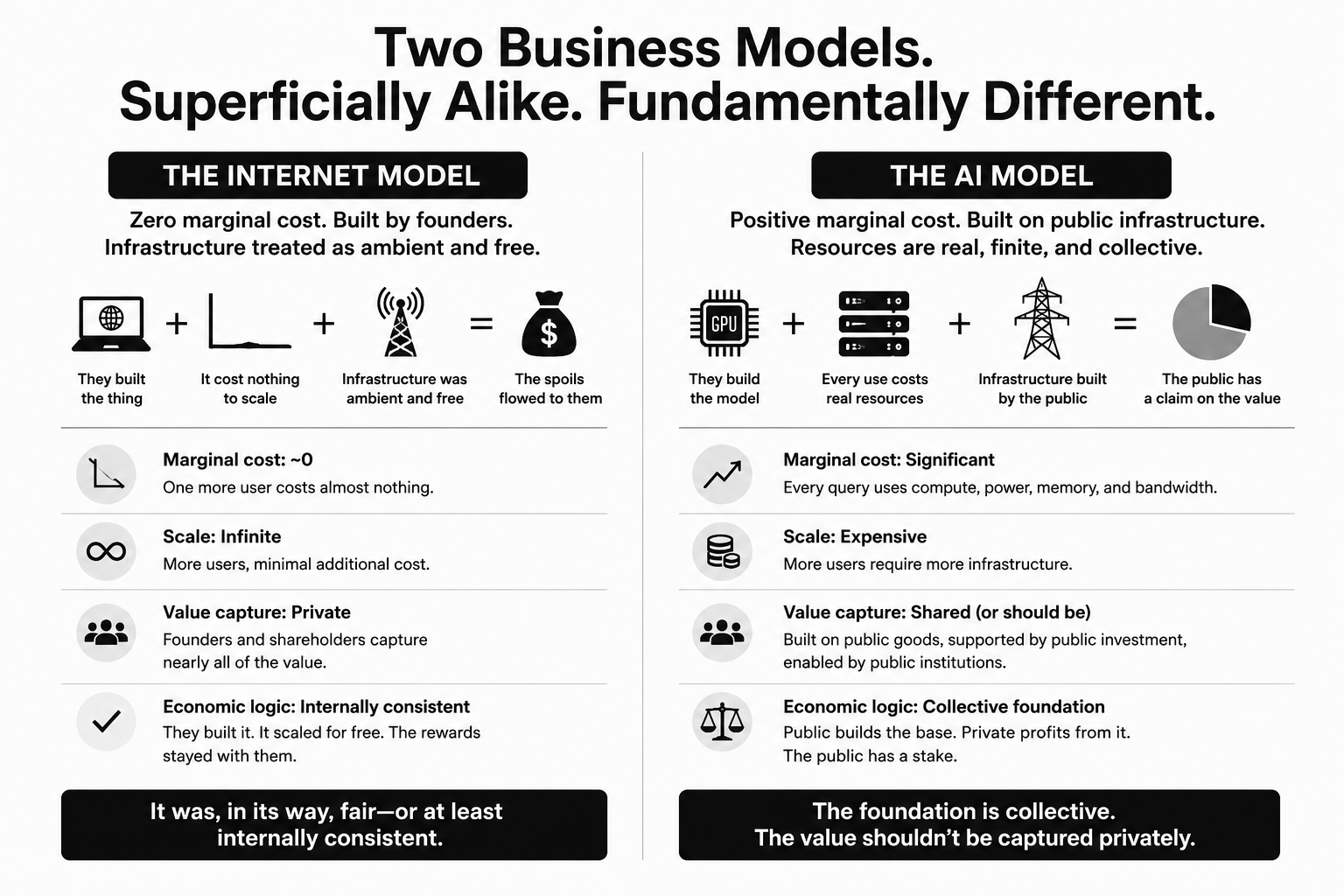
So we are left with two business models that look superficially alike and are, underneath, almost nothing alike.
The internet had zero marginal cost and was built by its founders on infrastructure they could treat as ambient and free. That combination is why the founders captured nearly all of the value. They built the thing, the thing cost nothing to scale, and the spoils flowed to them. It was, in its way, fair—or at least internally consistent.
AI has real marginal cost and runs on infrastructure that was built by everyone. That combination changes the math of who has a claim on what gets built. When the costs are real and the foundation is public, the question of ownership stops being rhetorical and starts being a negotiation. The only thing left to settle is who shows up to the table, and what kind of leverage they bring.
The roads are already built. The traffic is already flowing. The only question that remains is the oldest one in commerce, the one the landlord always eventually asks.
How much of this should I own?



Member discussion